Ezra, meet Bucky
The encounters of the poet Ezra Pound with Buckminster Fuller.

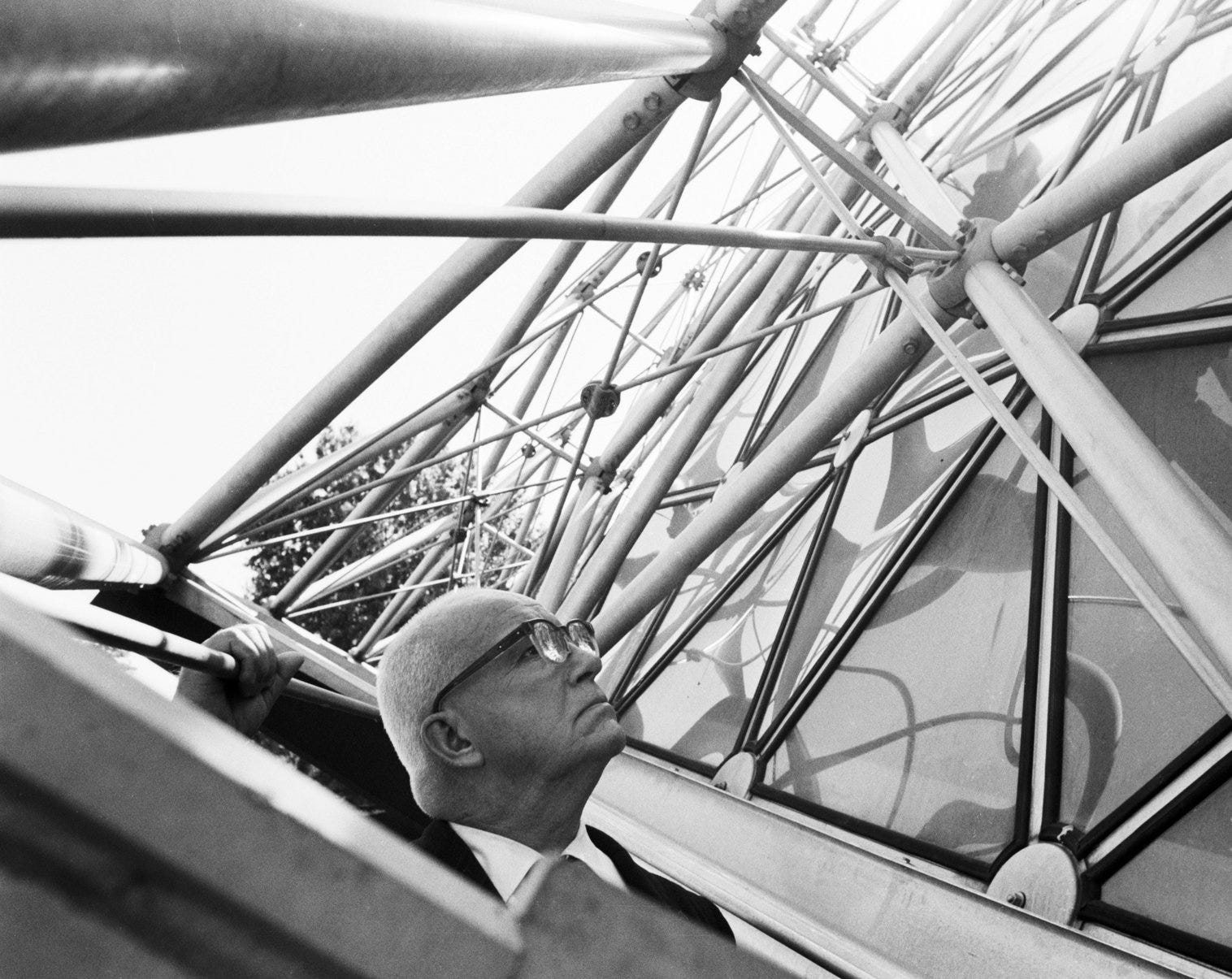
In 1967 the German-born American documentary film-maker Michael Blackwood filmed the Festival dei Due Mondi in Spoleto, Italy. With no commentary, Blackwood’s film is an artistic black and white meander through the many events and personalities of the festival—there are ballet dancers practising, an opera featuring Henry Moore sculptures, R. Buckminster Fuller in conversation with Moore and Festival founder Gian Luca Menotti discussing how eyes age and how to capture them in art, John Berryman asking Allen Ginsberg to get him another whisky, the process of erecting a Fuller-inspired dome and an interview with its creator, and Menotti commenting on the ‘marvellous acoustics’ of the dome (nicknamed the ‘Spoletosphere’, it was where Philip Glass performed during the Festival). Buckminster Fuller walks around like a bank manager among a crowd of dissolutes. In a fleetingly frail appearance, the poet Ezra Pound emerges into the square at Spoleto with a young woman guiding him and asking Menotti where the poet’s car might be. In an Italian summer, Pound is wearing a coat on top of his light coloured suit, and his partner Olga Rudge is just behind him.
Ezra, meet Bucky.
It was at the 1967 Spoleto Festival that Pound briefly met Buckminster—Bucky— Fuller for the first time. Later, in 1970, the two dined together, once again at Spoleto, accompanied by the sculptor Isamu Noguchi—‘Ezra, of course, never talked,’ a fellow diner recalled. ‘He was famous for that. So Isamu would lean over and take the knife and fork, cut Ezra’s food for him, and hand then back and say, “Now, Ezra, eat!” And Ezra would pick up his fork and start eating.’
The meetings clearly made an impression. In October 1970 Fuller delivered a lecture series at the International University of Art in Venice and the poet was in the front row for every lecture—an impressive commitment as Fuller spoke for eight unscripted hours a day. Fuller went for a tour of Venice lagoon with his wife Anne, Noguchi, Priscilla Morgan (Noguchi’s partner who eventually became associate director of the Festival), Pound and Olga Rudge. They shared pomegranates for lunch and later in the afternoon filmed on the island of San Giorgio Maggiore where Fuller commented on the beauty of the pine cones.
Later in the evening, Bucky and Anne Fuller visited Pound and Olga at their home on Calle Querini. When they left, Olga chased after them to present a signed copy of The Cantos. Pound had written inside: ‘The gold from the pine cones—the pomegranate.’ Olga read Fuller’s 1969 Nehru lecture to Pound late into the night. The lecture’s title was ‘The Leonardo Type’ which might have struck a chord.
The poet and Fuller met again at Spoleto in June 1971. Pound read from Drafts and Fragments and gave Fuller an inscribed copy:
To Buckminster Fuller
friend of the universe
bringer of happiness
liberator.
With affectionate admiration
Ezra Pound
Spoleto
June 29th 1971.
Fuller was proud of the inscription—‘“Friend of the universe!” For nobility of phrasing one goes to a pro.’—and uses it at the start of his 1972 book, Intuition.1
They never saw each other again.
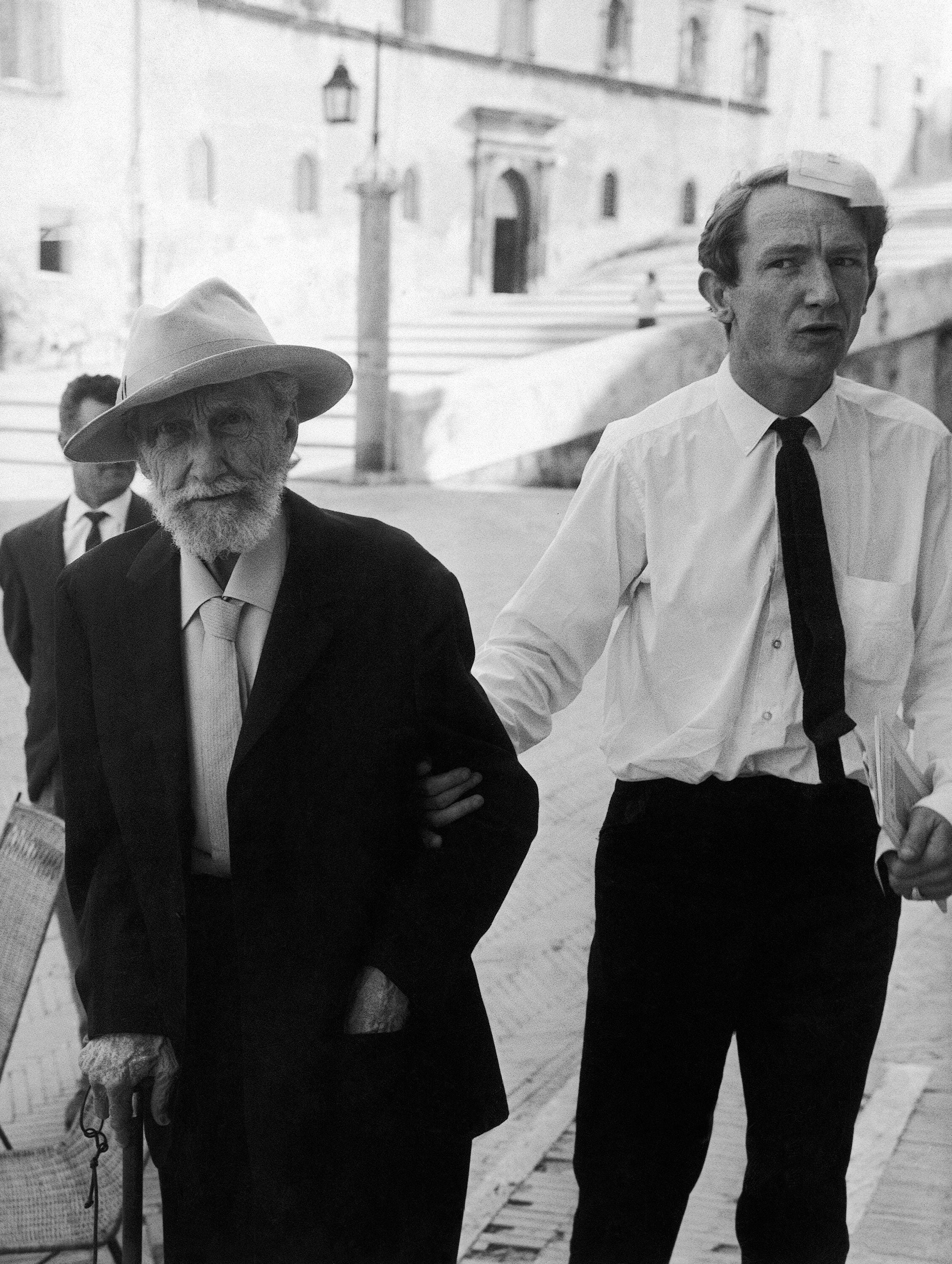
There are so many curious parallels, shared views, passions, experiences, intolerances, synchronicities and overlapping networks between Ezra Pound and Buckminster Fuller that the most astonishing thing is that they met only a handful of times in old age when Pound was in his eighties and Fuller in his seventies. ‘That conversation should have been going on for 30 years. Exile has its disadvantages,’ said the Pound scholar Guy Davenport.2
Their shared ability to build personal connections makes this even more surprising. Both Fuller and Pound were arch networkers.
In London at the beginning of the century the poet quickly infiltrated the London literary scene and established his own loose gathering of like minds. In Paris in the early 1920s he tapped into the foreign artistic and literary communities, making lifelong allies and friends. In Rappalo from 1925, he attracted disciples and also built a network through his relentless correspondence (amounting to some 100,000 letters in his life). And, in later life Pound connected with the new generation of poets including Charles Olsen, Robert Lowell, Ginsberg and Berryman.
Fuller was similarly highly networked. A continual globetrotter, his somewhat random network included musicians (John Cage and Paul Robeson); artists (Willem de Kooning, Salvador Dali, Alexander Calder, and Andy Warhol,); authors (Theodore Dreiser, Truman Capote, William S. Burroughs, C. P. Snow, and Studs Terkel); and political leaders (Jawaharlal Nehru and Indira Gandhi). Along the way he also encountered the dancer Martha Graham, L. Ron Hubbard, Al Capone, the architects Norman Foster, Ludwig Mies Van der Rohe and Frank Lloyd Wright (‘I am an architect interested in science, Buckminster is a scientist interested in architecture.’3), film director John Huston, and the designer Charles Eames. In keeping with this broadest of churches, the singer John Denver was a Fuller fan.
There was some overlap in the networks of the two men—including the poet Archibald Macleish, Samuel Beckett, Frank Morley from the publishers Faber, Marshall McLuhan, and the poet E. E. Cummings. Fuller also knew and fell out with the poet Charles Olsen who visited Pound when he was in St Elizabeths (and also met the poet at Spoleto in 1965).
A shared contact was the scholar Hugh Kenner who wrote books about both men—The Pound Era (1971) and A Guided Tour of Buckminster Fuller (1973)—and built a geodisc dome in his Santa Barbara garden. Of Fuller he observed: ‘Bucky’s work, seen part by part, is a story of crisis and failure, buildings that don’t get built, industries that don’t get financed, theories that done get heard. Seen whole, it is an effort to develop a vast new paradigm, the synergetic vision.’4 An under-current of glorious failure is something shared by Fuller and Pound. The engineer/architect championed dome-building projects which rarely saw the light of day and, when they did, were often beset with problems of varying kinds—‘I only learn what to do when I have failures,’ he noted.5 At the heart of Fuller’s work was an ambition to challenge received wisdom about the kind of building structures necessary for mankind to survive and thrive.
Similarly, Pound’s Cantos offer a wholesale challenge to how poetry is structured and understood. Both Fuller and Pound offered big and bold assaults on received wisdom and practice. There were domes with leaks and impenetrable poems along the way. Hugh Kenner argues that Fuller shared the modernist willingness to imagine great works with a minimal structure, ‘an ambitious project can be sustained without what book-reviewers mean by “structure”; a framework of narrative, a framework of logic, sometimes foursquare to which the elements are fitted like clapboards and shingles’.6 Fuller wanted to re-invent the framework of a house, Pound the framework of poetry.
Grandiose self-confidence and risk-taking brilliance are the often uneasy counterparts of the careers and achievements of both. Kenner reflects: ‘Working on Cathay in 1914, Ezra Pound misconstrued detail after detail of Chinese poems he knew only through the Tokyo class-notes of a Harvard-educated half-Spaniard; yet grasping the poem’s Whole System, he made translations before which scholarship is helpless.’7 The willingness to offer translations of poems in a language you have very little understanding of is one demonstration of the breathless chutzpah of Pound’s work. So, too, are his musical projects of the 1920s having displayed little aptitude for musical composition or performance.
Similar logic encouraged Pound to think of himself as an economist in the 1930s. While his reading on the subject was wide it tended to be of works supporting his ideas and prejudices. More widely read specialists—such as John Maynard Keynes—were crudely dismissed. Pound bridled at any suggestion that his interest in economics was that of an enthusiastic amateur and that it detrimentally impacted his poetry.
A key figure in Pound’s life, the economist and champion of social credit C. H. Douglas, was also known to Fuller—‘I read him in the 1930s.’8 Certainly, there was little difference in their views on economics. Fuller’s idea of the ‘contact economy’, in which a world commonwealth allocates resources to nations with businesses renting materials from governments echoes social credit.
Fuller also skated between knowledge and ignorance. A review of his book Nine Chains to the Moon observes: ‘The author has sound knowledge of one thing and mere opinion on a thousand things. In the one thing that he knows well, namely architecture, he is a revolutionary. In the other things he is contradictory, self-contradictory, and just as likely to be reactionary as progressive.’ Along similar lines the artist Manuel Bromberg concluded: ‘He seemed to be a thinker and con artist at the same time.’ Fuller’s biographer reports: ‘As he became publicly known as a Renaissance man, Fuller often spoke on subjects of which he had minimal knowledge, using scraps of information gleaned from newspapers and his own itinerary.’9
Bucky, meet Ezra.
Wide-ranging in their interests and largely self-taught Pound and Fuller railed against being pigeon-holed or confined to a particular intellectual pursuit or category. Fuller was an architect, an engineer, a designer, a futurist, even the designer of a car, the Dymaxion. He worked at Fortune in the late 1930s and became an expert in industrialisation. He joined the Board of Economic Warfare during World War Two (the board was chaired by vice-president Henry A. Wallace who Pound had somewhat angrily corresponded with). Fuller was also a map maker, a poet (he became Charles Eliot Norton Professor of Poetry at Harvard in 1962, sharing the post with the architects Felix Candela and Pier Luigi Nervi) and referred to his ideas as ‘energetic geometry’.10
Both were enthusiastic marketers of their own ideas and those of their acolytes and disciples. Dymaxion (dynamism+maximum+ion) became Fuller’s personal brand. He emulated Le Corbusier by wearing a plain black suit—‘bank clerk’s clothing’—long before Steve Jobs donned a black turtle neck. It was, concludes his biographer Alec Nevala-Lee, ‘a lifelong performance’.11
Pound was similarly aware of his own ability to dress and perform. In London, newly arrived from America and with hardly a published poem or a pound to his name, he carried off the look of a poet cutting a swathe through literary London from Belotti’s in Soho to the rarified salons attended by Yeats. ‘Ezra, with his mane of fair hair, his blonde beard, his rimless pince-nez, his Philadelphian accent and his startling costume, part of which was a single turquoise ear-ring, contrived to look “every inch a poet”,’ recorded one observer.12 A profile article of Pound in the 1930s portrays him striding down the promenade at Rapallo in a dressing gown with a towel over his shoulder and a crowd of children following him like a poetical Pied Piper.
For Fuller and Pound the performance was an act of self-fulfilling promotion. Fuller became regarded as a Renaissance man, Pound as a groundbreaking poet. Though both would have considered themselves teachers, they were more accurately brilliant talkers about and promoters of their own ideas, experiences, passions and prejudices. ‘He’s not a teacher—he just talks,’ noted the designer Harold Cohen of his friend Fuller. Early in life, at Romany Marie’s in Greenwich Village, Fuller was made the tavern’s ‘official talker’.13
For both, holding forth on stage or simply in front of an audience of fellow diners in a restaurant was natural. So, too, was a feeling or desire to capture all of their own brilliance and experience. The Cantos is a sprawling journey through Pound’s life and mind. Similarly, Fuller constantly hoped to capture everything. In January 1975 he recorded video sessions which became known as ‘Everything I know’—covering engineering, autobiography and geometry. Both Fuller and Pound were driven to share the completeness of their own brilliance.
And it worked. The force of their talking and personalities, their sheer relentlessness, meant that they attracted disciples, true believers. ‘I am your disciple. I’ve joined your conspiracy,’ Marshall McLuhan told Fuller.14 The futurist Alvin Toffler described Fuller as ‘the leader of something approaching a religious movement’.15 Similarly, Pound attracted acolytes and disciples who he hoped to activate into missionaries going out into the literary world preaching his modernist gospel or whatever bugbear was currently occupying his mind. Poets including Ronald Duncan, Basil Bunting and Louis Zukofsky made the trek to Rapallo to sit and listen as Pound lectured them in the restaurant below his apartment. James Laughlin visited and was converted from a would-be poet into a much more useful publisher. Others, such as the poet Mary Barnard remained epistolary disciples, receiving a steady stream of feedback, directions and admonishments.
Pound’s longer lasting impact was through his friendship with James Joyce, W. B. Yeats and T. S. Eliot. They were strong and independent enough to take his feedback and advice when it was useful to them or chimed with their own beliefs. Similarly, there were those who took Fuller’s ideas and work and merged it with their own thinking. These included Edwin Schlossberg who pioneered interactive design and Stewart Brand, the author of The Whole Earth Catalog, who Fuller met in 1967. In the Catalog, Brand described Fuller as ‘one of the most original personalities and functional intellects of the age’.
‘WHY does American genius invariably weave in and out of crankery?’ asks Hugh Kenner contemplating Fuller’s life and work. ‘And one reason Bucky’s trail is strewn with ex-disciples is that the crankery eventually gets through to them.’16 Genius and crankery, ego and innocence, grand failure and brilliant imagination, stalk the stories of the lives of both Fuller and Pound. Fuller described Pound as a ‘tremendously hurt man’ and admitted that he saw himself in the poet.17
The legacy of their meetings was limited. The film producer Robert Snyder (Fuller’s son-in-law) talked of producing a documentary on Pound as part of a series which included films of Fuller, Henry Miller and others. It didn’t happen. Amid a fusillade of names and places, Pound mentions ‘Buckie’ in Canto 97. Theirs was a strong connection of kindred spirits encountered too late in their lives.
Resources
Fuller talked about meeting Pound in his lecture ‘Pound, Synergy and the Great Design’ and writes about it in Humans in Universe (with Anwar Dil, New York: Mouton, 1983, pp. 20-25). The Pound/Fuller meetings in Spoleto and Venice are captured in the excellent Alec Nevala-Lee, Inventor of the Future (New York: Harper Collins, 2022).
Stuart Crainer is an author, editor, adviser and entrepreneur. He is co-founder of Thinkers50. His book credits include The Financial Times Handbook of Management, The Management Century, and Generation Entrepreneur (with Des Dearlove). He is the author of the poetry collection, Atlantic Crossing.
Edward M. Burns (ed.), Questioning Minds: The Letters of Guy Davenport and Hugh Kenner, Volume 2 (Berkeley, California: Counterpoint, 2018), p. 1391.
Edward M. Burns (ed.), Questioning Minds: The Letters of Guy Davenport and Hugh Kenner, Volume 2 (Berkeley, California: Counterpoint, 2018), p. 1321.
Alec Nevala-Lee, Inventor of the Future (New York: Harper Collins, 2022), p. 299.
Hugh Kenner, A Guided Tour of Buckminster Fuller (New York: William Morrow, 1973), pp. 299-300.
Alec Nevala-Lee, Inventor of the Future (New York: Harper Collins, 2022), p. 231.
Hugh Kenner, A Guided Tour of Buckminster Fuller (New York: William Morrow, 1973), p. 6.
Hugh Kenner, A Guided Tour of Buckminster Fuller (New York: William Morrow, 1973), p. 299.
Alec Nevala-Lee, Inventor of the Future (New York: Harper Collins, 2022), p. 192.
Alec Nevala-Lee, Inventor of the Future (New York: Harper Collins, 2022), p. 192, p. 166 and p. 333.
Alec Nevala-Lee, Inventor of the Future (New York: Harper Collins, 2022), p. 190.
Alec Nevala-Lee, Inventor of the Future (New York: Harper Collins, 2022), p. 190.
Douglas Goldring, South Lodge: Reminiscences of Violet Hunt, Ford Madox Ford and the English Review Circle (London: Constable & Company, 1943), p. 40.
Alec Nevala-Lee, Inventor of the Future (New York: Harper Collins, 2022), p. 303 and p. 119.
Alec Nevala-Lee, Inventor of the Future (New York: Harper Collins, 2022), p. 321.
Alvin Toffler, The Futurists (New York: Random House, 1972), p.6.
Edward M. Burns (ed.), Questioning Minds: The Letters of Guy Davenport and Hugh Kenner, Volume 2 (Berkeley, California: Counterpoint, 2018), p. 1404.
Buckminster Fuller, Pound, Synergy and the Great Design (Moscow: University of Idaho, 1977), p. 2.